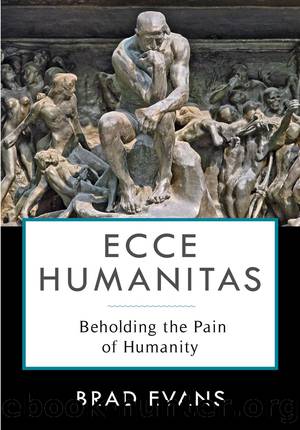
Ecce Humanitas: Beholding the Pain of Humanity by Brad Evans
Author:Brad Evans [Evans, Brad]
Language: eng
Format: epub
Tags: Philosophy/Political, Social Science/Violence in Society, Social Science, Aesthetics, PHI019000, philosophy, Violence in Society, Political, political science, SOC051000, History & Theory
ISBN: 9780231545587
Google: jcQIEAAAQBAJ
Publisher: Columbia University Press
Published: 2021-07-20T00:26:54.235550+00:00
CHAPTER 6
A Sickness of Reason
SICKNESS OUT THERE
There was a sickness out there. And it struck us down with silence. Even when people were in close proximity, their voices were noticeably quieter. It was like the world had become a solemn cathedral in which we collectively mourned, where we all whispered and seemingly had greater respect for, yet also greater fear of, the very air we breathed. Thatâs perhaps what Dante didnât fully appreciate. Purgatory was not always full of howling screams; it could also be deadly silent. And yet, many noted how the beauty remained. Nature had never looked so majestic, its sounds so delicate, its innocence more pronounced. It felt like the animal world had found a new freedom, which forced us to take note in our humbled and vulnerable state. We were all thrown into a humanitarian crisis, borderland conditions of anxiety now thriving within every single metropolis, while the ecological conditions of life managed to replenish themselves. But there was a sickness out there, that much couldnât be denied. And the lockdown only added to the silence, the alienation, the remoteness. Maybe the sickness was already within us, coursing through our systems. And yet we continued, haunted by the other pandemics we had chosen to ignore, plagued by our own inhumanity and failure to take seriously the biospherical conditions that constituted planetary life.
What we would come to appreciate more fully was how humanity had been sacrificed at the altar of its own failed realization. As the COVID-19 pandemic spread across the world, there was a glimmer of hope that something called humanity might just emerge from the shadows of isolation. That dream ended quickly, as the eruption of racial violence provided a stark reminder that liberalism had never resolved the problem of race that was its own creation. As early narratives of war that appeared at the start of the outbreak ensured that the sacrificial was already being discursively reset, the true accelerationists and technocratic visionaries were already prepared to take advantage of the emerging postliberal disorder. The governing logics were already in the making and the technologies for control already in production. Tracking and surveillance systems were developed by a technological army, faceless and nameless, with no national allegiance to speak of, nor a doctrine to advance. They were not only part of the fight against the virus, key to how we might emerge into the ânew normality,â they were the principal architects of this postliberal world. For quite some time, those who had been operating in the atmospheric shadows, watching over us like some science fiction fantasy waiting to strike, now appeared as real as the virus that sought to also inhabit every organ we possessed. What they needed was a crisis devastating enough to provide the necessary conditions of possibility. The sacred order of liberalism had passed. And the victim, as we had seen, was defined only by its literal absence. They too had become as invisible as the virus that had killed them.
Giorgio Agamben would be open to ethical question on a number of points (see below).
Download
This site does not store any files on its server. We only index and link to content provided by other sites. Please contact the content providers to delete copyright contents if any and email us, we'll remove relevant links or contents immediately.
| Anthropology | Archaeology |
| Philosophy | Politics & Government |
| Social Sciences | Sociology |
| Women's Studies |
Born to Run: by Christopher McDougall(7132)
The Leavers by Lisa Ko(6952)
iGen by Jean M. Twenge(5419)
Sapiens by Yuval Noah Harari(5375)
Spare by Prince Harry The Duke of Sussex(5202)
The Kite Runner by Khaled Hosseini(5188)
Machine Learning at Scale with H2O by Gregory Keys | David Whiting(4317)
Bullshit Jobs by David Graeber(4197)
Never by Ken Follett(3963)
Goodbye Paradise(3813)
Livewired by David Eagleman(3778)
Fairy Tale by Stephen King(3403)
A Dictionary of Sociology by Unknown(3088)
Harry Potter 4 - Harry Potter and The Goblet of Fire by J.K.Rowling(3077)
The Social Psychology of Inequality by Unknown(3039)
The Club by A.L. Brooks(2930)
Will by Will Smith(2930)
0041152001443424520 .pdf by Unknown(2850)
People of the Earth: An Introduction to World Prehistory by Dr. Brian Fagan & Nadia Durrani(2740)
